Navigating the intricacies of South African labour law is a critical task for any HR manager, particularly within small and medium enterprises (SMEs). The choice between a fixed-term contract and permanent employment profoundly impacts operational flexibility, cost management, and legal compliance. This guide offers a direct, authoritative comparison to help you make informed decisions that align with your business objectives while mitigating significant legal risks under the Labour Relations Act (LRA).
Fixed-term contracts in South Africa are agreements for a specified period or project, automatically terminating upon reaching that end point or project completion, whereas permanent employment offers indefinite tenure, requiring formal termination processes based on fair reasons. Understanding the nuances, particularly regarding Section 198B of the LRA, is essential for SMEs to avoid costly CCMA disputes and ensure long-term stability.

Disclaimer: This article provides general information and guidance regarding fixed-term and permanent employment contracts under South African labour law. It is intended for informational purposes only and does not constitute legal advice. While efforts have been made to ensure accuracy, labour law is complex and subject to interpretation and change. HR managers and SMEs should consult with a qualified labour law professional for advice tailored to their specific situations.
1. Defining the Contenders: Fixed-Term vs. Permanent Contracts in SA
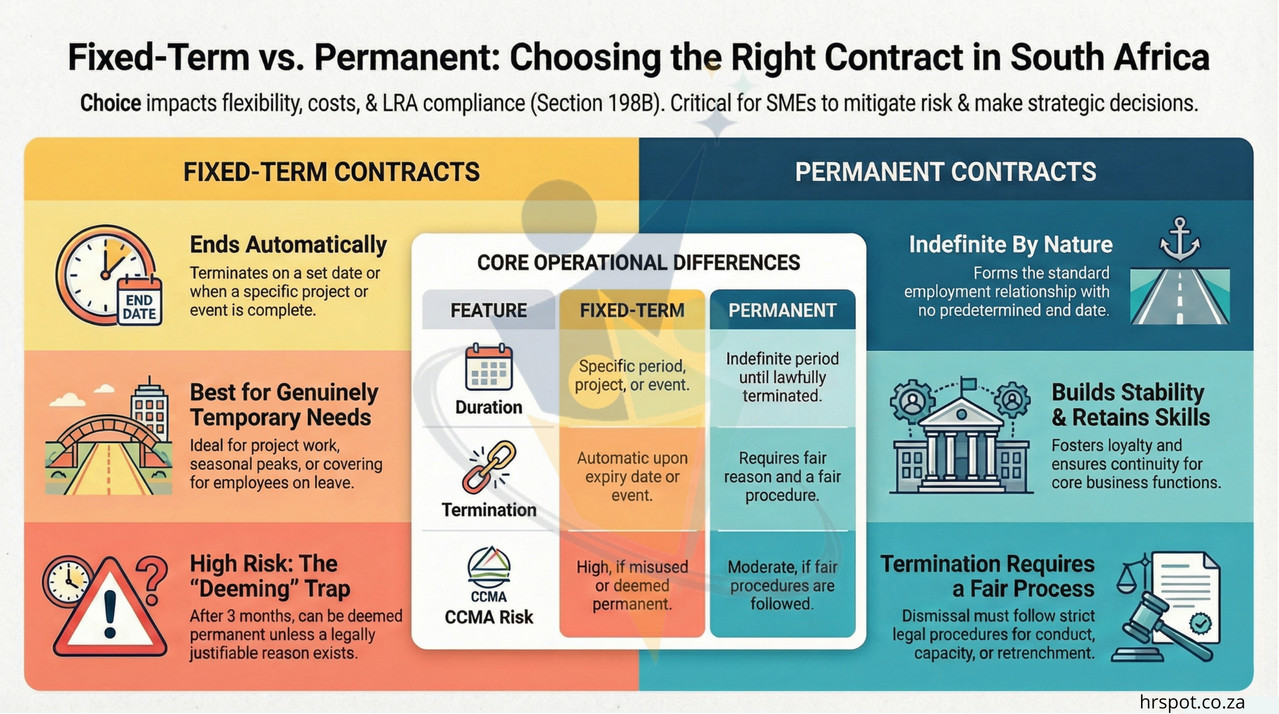
A fixed-term contract employs someone for a defined period or until a specific project ends, and terminates automatically without notice. A permanent contract has no end date and continues until either party lawfully terminates it, giving the employee ongoing rights such as notice periods and protection against unfair dismissal.
The foundational difference between fixed-term and permanent contracts lies in their duration and the conditions under which they conclude. In South Africa, these distinctions are critical and governed primarily by the Labour Relations Act 66 of 1995 (LRA), as amended.What constitutes a Fixed-Term Contract under the LRA?
A fixed-term contract is an employment agreement that terminates automatically:- On a specified date.
- Upon the completion of a specific project or task.
- Upon the occurrence of a specific event.
The nature of Indefinite (Permanent) Employment
Permanent, or indefinite, employment forms the backbone of the standard employment relationship in South Africa. It signifies an agreement without a predetermined end date, implying continuous service until one party lawfully terminates it. Termination of a permanent contract requires a fair reason, related to conduct, capacity, or the employer’s operational requirements and adherence to fair procedure, as enshrined in Sections 185 to 197 of the LRA. This provides employees with significant job security and places a considerable burden on employers to manage performance, discipline, and restructuring processes diligently. ⭐Key Takeaway: The primary distinction is the automatic termination feature of a fixed-term contract versus the open-ended nature of permanent employment, which necessitates a legally compliant termination process.2. At a Glance: Key Differences Comparison Table
To provide a clear overview for busy HR managers, the following table summarises the core differences between fixed-term and permanent employment contracts in South Africa.| Feature | Fixed-Term Contract | Permanent Employment |
|---|---|---|
| Duration | Specific period, project completion, or event. Automatically terminates. | Indefinite period. Continues until lawfully terminated by either party. |
| Termination Process | Automatic termination upon expiry or event. No notice or formal process required at expiry, provided it is not deemed permanent. Premature termination requires agreement or payment in lieu. | Requires fair reason (conduct, capacity, operational requirements) and fair procedure (e.g., disciplinary hearing, performance counselling, Section 189 retrenchment consultation). Requires notice periods. |
| Benefits Eligibility | If employed for more than 3 months (and below BCEA threshold), generally entitled to same benefits as permanent employees doing similar work, pro-rata (e.g., leave, medical aid contribution). Exemptions apply. | Full benefits as per company policy, employment contract, or collective agreement (e.g., leave, medical aid, provident fund). |
| Severance Obligations | Severance pay required if contract exceeds 24 months and not renewed for operational requirements, calculated per Section 35 of BCEA (1 week per completed year). No severance if renewed or employment for less than 24 months. | Severance pay (1 week per completed year) typically required only in cases of retrenchment due to operational requirements. Not required for termination due to conduct or capacity. |
| CCMA Risk Level | High if not used for a justifiable reason, automatically renewed multiple times, or terminated prematurely without cause. Risk of being ‘deemed’ permanent. | Moderate, provided fair reasons and fair procedures are followed for termination. High risk if dismissal is procedurally or substantively unfair. |
| LRA Section 198B Applicability | Highly relevant for employees earning below the BCEA threshold, especially the 3-month ‘deeming’ provision and justifiable reasons. | Not directly applicable to the contract’s nature, but LRA Sections 185-197 govern fair dismissal. |
3. When to Use Fixed-Term Contracts: Strategic Use Cases
For South African SMEs, fixed-term contracts can be a strategic tool when deployed correctly and for justifiable reasons. Section 198B(3) of the LRA outlines specific scenarios where such contracts are permissible beyond the initial 3-month period for employees earning below the Basic Conditions of Employment Act (BCEA) earnings threshold. 💡Tip: Always ensure the reason for the fixed-term contract is genuinely linked to the operational needs and documented explicitly in the contract. Here are the primary strategic use cases for fixed-term contracts:- Project-based work and seasonality: If your business undertakes specific projects with a defined start and end date, or experiences predictable seasonal fluctuations in workload (e.g., agriculture, tourism, retail during peak holidays), fixed-term contracts are ideal. They allow you to scale your workforce up or down without the long-term commitments of permanent employment. For instance, hiring additional staff for a three-month marketing campaign or extra hands during the December holiday rush.
- Replacing employees on maternity, sick, or sabbatical leave: When a permanent employee is temporarily absent for an extended period, a fixed-term contract can be used to engage a replacement. This ensures business continuity without overstaffing once the permanent employee returns. The contract should specify the duration as “until the return of [Employee Name]” or a specific date coinciding with the expected return.
- Student and graduate programmes: Engaging students, interns, or recent graduates for a defined period to gain work experience or complete a structured learning programme is a legitimate use of fixed-term contracts. These programmes are often designed to equip individuals with skills, with no guarantee of permanent employment thereafter.
- Temporary increase in workload: If your SME faces an unexpected but temporary surge in demand that cannot be met by your existing permanent staff, fixed-term contracts can provide the necessary short-term capacity.
- Newly established businesses: Employers in a new business (less than 24 months old) are exempt from certain aspects of Section 198B, allowing them more flexibility in using fixed-term contracts during their formative period. This can be crucial for managing initial overheads and assessing long-term staffing needs.
4. The Legal Trap: Section 198B and the ‘Deeming’ Provision
Section 198B of the LRA is arguably the most critical piece of legislation governing fixed-term contracts for SMEs in South Africa. Its primary objective is to prevent the abuse of fixed-term contracts by deeming certain contracts as permanent after a specified period, thereby affording employees greater protection.The 3-month threshold explained
For employees earning below the BCEA earnings threshold (which is reviewed annually, currently R254,371.67 per annum as of March 2023), Section 198B states that a fixed-term contract will be “deemed” to be an indefinite contract of employment if the employee has been employed for more than three months. This automatic deeming occurs unless the employer can demonstrate a “justifiable reason” for the fixed-term nature of the contract. The justifiable reasons are precisely those outlined in Section 198B(3) and discussed in the previous section (e.g., project work, temporary replacement). 🛑WARNING! Once deemed permanent, all protections afforded to permanent employees—including requirements for fair reason and procedure for dismissal—apply. This significantly escalates the risk and complexity of termination.
Exemptions for small businesses and high earners
Crucially for SMEs, Section 198B provides specific exemptions:- Employers with fewer than 10 employees: If your business has fewer than 10 employees, Section 198B does not apply. This provides significant flexibility, allowing you to use fixed-term contracts without the “deeming” provision, irrespective of duration or reason.
- Employees earning above the BCEA earnings threshold: The provisions of Section 198B do not apply to employees who earn above the BCEA earnings threshold. For these high-earning individuals, fixed-term contracts can be used with greater flexibility, although caution against the “reasonable expectation of renewal” principle (discussed next) is still advised.
- New businesses (less than 24 months old): For the first two years of operation, new businesses are also exempt from certain aspects of Section 198B regarding the justifiable reasons for fixed-term contracts.
5. The ‘Reasonable Expectation’ of Renewal Risks
Beyond Section 198B’s direct deeming provisions, one of the most common pitfalls for employers using fixed-term contracts is inadvertently creating a “reasonable expectation of renewal.” This risk applies to all employees, regardless of earnings threshold or company size.How rolling contracts create permanent status
If an employer repeatedly renews a fixed-term contract, even with short breaks in between, the employee can argue that they had a legitimate expectation that their contract would be renewed again, or that they would be offered permanent employment. This is particularly true if:- The contract has been renewed multiple times for similar or identical work.
- The employer has failed to give proper notice that the contract would not be renewed.
- The employee’s duties become integral to the ongoing operation of the business rather than a temporary project.
- Promises or representations were made about future employment.
Precedents from the CCMA
The Commission for Conciliation, Mediation and Arbitration (CCMA) frequently deals with cases involving the reasonable expectation of renewal. A classic example might involve an SME hiring a receptionist on a six-month fixed-term contract, which is then renewed for another six months, and then another, possibly over several years. Even if the fixed-term contracts explicitly state there’s no expectation of renewal, the conduct of the employer (repeated renewals) can override the written clause. Scenario: The Receptionist Renewed 4 Times An SME hires a receptionist on a 6-month fixed-term contract to cover a temporary administrative backlog. The contract is renewed three more times over two years, each time for similar administrative duties. When the employer decides not to renew the contract a fifth time, the receptionist approaches the CCMA, claiming an unfair dismissal due to a reasonable expectation of renewal. Despite clear clauses in the contract stating no such expectation, the CCMA considers the pattern of renewals and the consistent nature of the work, potentially ruling in favour of the employee due to the employer’s conduct creating the expectation. ⭐Key Takeaway: Regular renewal of fixed-term contracts, particularly for core business functions, is a significant red flag. If a role is ongoing, permanent employment is the safer and more legally compliant option.6. Financial Implications: Cost-Benefit Analysis
The choice between fixed-term and permanent contracts extends beyond legal compliance; it has tangible financial consequences for your SME. A thorough cost-benefit analysis must consider not just direct salaries but also benefits, severance, and potential litigation costs.Benefit parity requirements
For employees earning below the BCEA earnings threshold, Section 198B(5) mandates that employees on fixed-term contracts for more than three months must be treated “on the whole no less favourably” than permanent employees performing the same or similar work, unless there is a justifiable reason for different treatment. This means fixed-term employees are generally entitled to the same benefits, pro-rata, as their permanent counterparts, including:- Annual leave, sick leave, and family responsibility leave (as per BCEA).
- Access to medical aid, provident fund, or other company-provided benefits (pro-rata).
- Equal pay for equal work.
Severance pay calculations (Section 35 of BCEA)
Severance pay is another critical financial consideration.- Fixed-Term Contracts: If a fixed-term contract is not renewed, and the employee has completed at least 24 months of continuous service with the employer, they are entitled to severance pay. This is calculated at one week’s remuneration for each completed year of continuous service, in accordance with Section 35 of the BCEA. This applies unless the employee is offered an alternative position with the same employer (or an associated employer) on similar terms and refuses it.
- Permanent Employment: Severance pay is typically only required for permanent employees if their employment is terminated due to the employer’s operational requirements (retrenchment) after completing at least 12 months of service. It is also calculated at one week’s remuneration for each completed year of service.
7. Termination and Dismissal: Which is Easier to Manage?
The ‘exit strategy’ is often a major factor for SME HR managers when choosing between contract types. While fixed-term contracts appear simpler, both carry distinct risks if not managed correctly.- Fixed-Term Contracts: Automatic Termination (with caveats) The primary advantage of a properly managed fixed-term contract is its automatic termination upon expiry. No notice period, no disciplinary hearing for the termination itself, and no operational requirements process are needed, provided:
- The contract has a justifiable reason as per Section 198B(3) (if applicable).
- No reasonable expectation of renewal has been created. However, premature termination of a fixed-term contract is highly risky. If you terminate a fixed-term contract before its agreed expiry date without a valid reason (e.g., serious misconduct or incapacity that justifies dismissal, or an automatic termination clause due to specific event that has occurred), you could be liable to pay the employee for the remainder of the contract period. This is often more costly than notice pay for a permanent employee.
- Permanent Employment: Fair Reasons and Procedures Terminating a permanent employee requires adherence to strict legal processes under the LRA. This typically involves:
- Misconduct: Disciplinary hearing, evidence, sanction.
- Incapacity (poor performance/ill health): Performance counselling, warnings, reasonable accommodation, medical assessments.
- Operational Requirements (retrenchment): Consultation process (Section 189), selection criteria, severance pay.
8. When to Choose Permanent Employment: Long-Term Stability
While fixed-term contracts offer flexibility, permanent employment remains the cornerstone for building a stable, productive, and compliant workforce, especially for core roles within your SME.Retention of core skills and culture
Permanent contracts foster loyalty and commitment. Employees with job security are more likely to invest in their roles, commit to company goals, and contribute to a positive organisational culture. For positions that require significant institutional knowledge, specialized skills, or leadership, permanent employment ensures continuity and reduces the costly churn associated with repeated hiring and training. Losing key staff frequently can severely impact productivity and client relationships.Reducing administrative burden
While the termination process for permanent staff is more involved, the ongoing administrative burden of managing fixed-term contracts can be significant. This includes:- Tracking expiry dates for numerous contracts.
- Ensuring justifiable reasons for renewal or non-renewal.
- Managing the risk of ‘reasonable expectation’ claims.
- Potentially drafting new contracts every few months or years.
9. Contract Drafting Checklist for SME Managers
The devil is in the detail when drafting employment contracts. For SMEs, a well-drafted contract is your primary defence against potential CCMA disputes. Here’s a critical checklist for HR managers:- Clearly State Contract Type and Duration: Explicitly state if it’s “Fixed-Term” and specify the exact start and end dates, or the project/event upon which it terminates. For permanent, state “Indefinite Duration.”
- Justifiable Reason Clause (for Fixed-Term): For fixed-term contracts for employees below the BCEA threshold employed for longer than 3 months, clearly and precisely articulate the justifiable reason for the fixed-term nature, referencing Section 198B(3) of the LRA.
- No Expectation of Renewal Clause (for Fixed-Term): Include a clear and unambiguous clause stating that the contract will not be renewed and that no expectation of renewal exists, explicitly stating the termination date/event. While not absolute protection, it strengthens your position.
- Job Description & Duties: A detailed job description helps clarify the scope of work and supports the “justifiable reason” for fixed-term roles (e.g., ‘Project Manager for [Specific Project]’).
- Remuneration and Benefits: Clearly outline salary, allowances, and any benefits, specifying if they are pro-rata for fixed-term employees (and ensure parity where legally required).
- Notice Period: Define notice periods for termination for permanent employees as per BCEA minimums. For fixed-term contracts, specify what happens in case of premature termination.
- Probation Clause: If applicable, include a probation period clause (ensure it’s fair and reasonable).
- Confidentiality & Restraint of Trade: Include these clauses as appropriate to protect your business interests.
- Governing Law & Jurisdiction: Specify South African law and CCMA/Labour Court as the dispute resolution forums.
- Signatures: Ensure both parties sign and date the contract.
- Review Regularly: Labour law evolves. Review your contract templates periodically to ensure compliance with the latest legislation and case law.
10. Final Verdict: Which Contract Suits Your Vacancy?
The decision between a fixed-term and permanent employment contract is not a one-size-fits-all answer. It demands a thoughtful assessment of the specific role, your business’s operational needs, and the prevailing legal landscape in South Africa. For HR managers of SMEs, the objective is to strike a balance between flexibility and legal compliance, always with an eye on risk mitigation. Consider this simple decision framework:- Is the role genuinely temporary or project-based with a clear, justifiable end?
- YES: A fixed-term contract may be suitable. Ensure it aligns with Section 198B(3) reasons and manage expectations carefully. If your SME has fewer than 10 employees or the employee is high-earning, you have more flexibility.
- NO: The role is ongoing, core to your business, or requires continuous service.
- THEN: Permanent employment is the appropriate and legally safest choice.
- Can you confidently avoid creating a ‘reasonable expectation of renewal’ for an ongoing need?
- NO (risk is too high): Permanent employment.
- YES (it’s truly a one-off temporary need): Fixed-term, with careful drafting and management.
Navigate Labour Law with Confidence
Making the right contracting choice is fundamental to your SME’s success and compliance in South Africa. If you are uncertain about the specific application of labour law to your unique circumstances or need assistance drafting compliant contracts, seeking expert legal advice is always recommended. Proactive legal counsel can safeguard your business against potential liabilities and ensure fair labour practices.Disclaimer: This article provides general information and guidance regarding fixed-term and permanent employment contracts under South African labour law. It is intended for informational purposes only and does not constitute legal advice. While efforts have been made to ensure accuracy, labour law is complex and subject to interpretation and change. HR managers and SMEs should consult with a qualified labour law professional for advice tailored to their specific situations.
Frequently asked questions
What is the difference between a fixed-term and a permanent employment contract?
A fixed-term contract employs someone for a defined period or until a specific project ends, and terminates automatically without notice. A permanent contract has no end date and continues until either party lawfully terminates it, giving the employee ongoing rights such as notice periods and protection against unfair dismissal.