Imagine it is Monday morning. An employee hands you a medical certificate to justify a week-long absence. However, instead of the usual letterhead from a local GP or a hospital, the note is from a traditional healer, citing “premonitions of ancestors” or a “calling” that required immediate spiritual attention.
For years, HR managers and employers have navigated this scenario with a sense of profound uncertainty. This “legal grey area” often forced a choice between appearing culturally insensitive or risking the abuse of sick leave policies. While the constitutional right to practise one’s culture has long been clear, the administrative integration of traditional healing into the formal workplace has remained murky. However, the landscape is shifting. The publication of the Traditional Health Professional Regulations in 2024 marks a definitive roadmap toward formalisation, moving South Africa from a “tolerant” medical system toward a truly “inclusive” one.
As a strategist, it is vital to understand that while the framework is being built, the implementation phase requires a sophisticated legal touch. Here are the five most surprising realities of this new era.
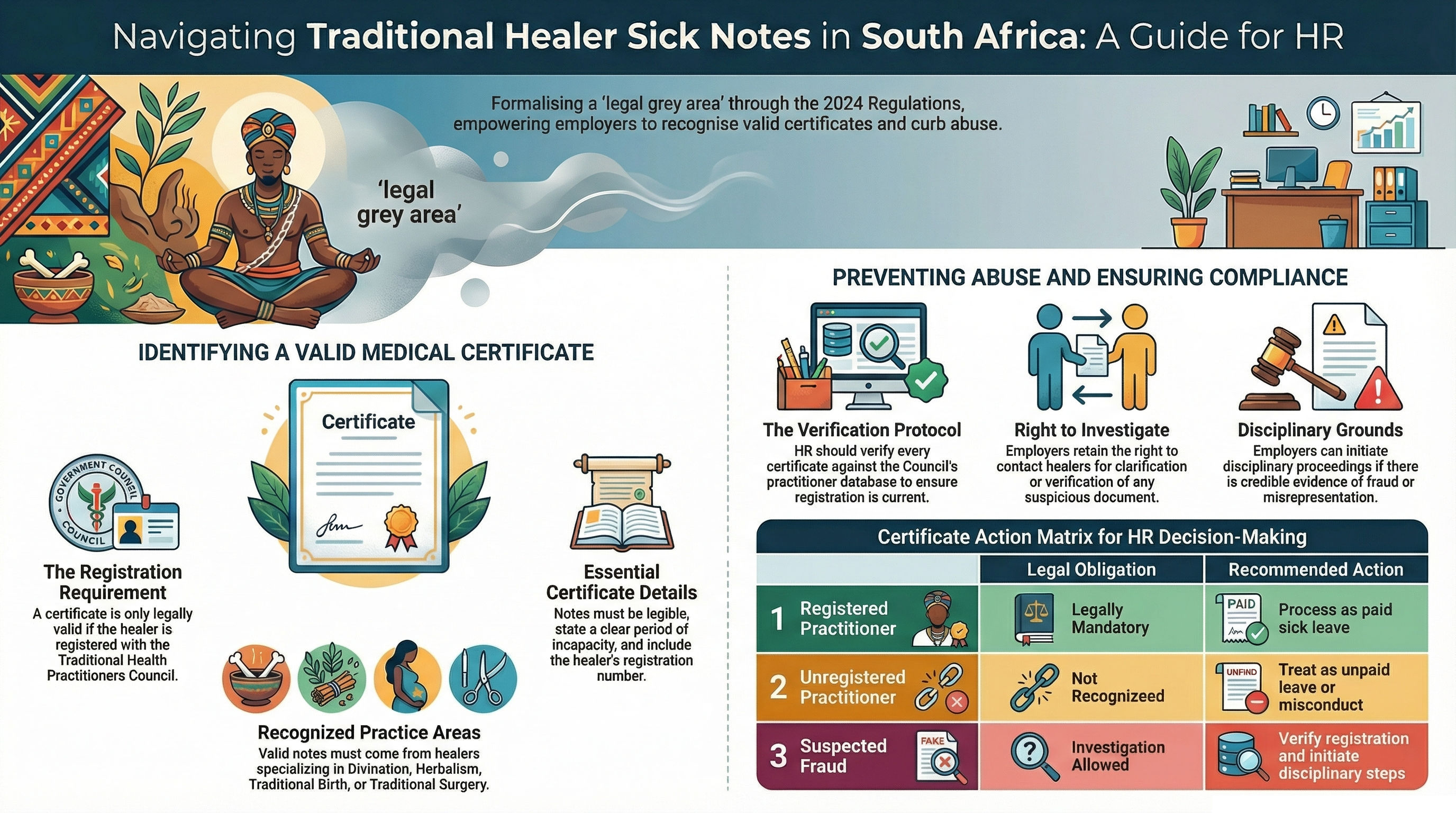
1. The Legal “Grey Area” is Closing – But Not Yet Shut
For decades, the legitimacy of medical leave certificates provided by traditional healers was a source of constant dispute. While traditional medicine was “tolerated” by law, it was not fully integrated into the statutory requirements of the workplace. The Traditional Health Professional Regulations, published for comment on 21 June 2024, have finally provided the framework to formalise and professionalise these practices.
Under the Basic Conditions of Employment Act (BCEA), read alongside the Traditional Health Practitioners Act (THPA), registered traditional healers are recognised as authorised professionals. However, a critical distinction for HR practitioners is that the Interim Traditional Health Practitioners Council is still in the process of finalising its registration systems.
“At the outset, it is essential that employers treat medical certificates issued by registered traditional health practitioners with the same legitimacy as those issued by conventional medical professionals.”
2. Registration is a Multi-Layered “Master Key”
The most important takeaway for any employer is that the legitimacy of a traditional healer’s note depends entirely on official registration with the Interim Traditional Health Practitioners Council. However, registration is not a “blanket” approval; it is highly specific.
To be legally recognised, a practitioner must be registered within one of four specific categories: Divination, Herbalism, Traditional birth attendant practices, or Traditional surgical practices (such as circumcision). Furthermore, the regulations enforce standards of “age, education, and specific training.” For example, student practitioners must meet a minimum age requirement and possess at least an ABET Level 1 general education.
Strategically, this means an employer has the right under Section 23(2) of the BCEA to reject certificates from unregistered practitioners or those acting outside their registered category. Until the Interim Council completes the registration of a healer, the employer is legally entitled to treat the absence as unpaid leave.
3. “Sincere Belief” Does Not Always Equal Paid Sick Leave
The landmark case of Kievits Kroon Country Estate v Mmoledi is often misinterpreted as a mandate to pay for all cultural absences. In reality, the court provided a much more nuanced lesson for HR departments.
The court found the dismissal of an employee who attended traditional healer training unfair, not because the note qualified as a “medical illness” under the BCEA, but because the employee had a “sincere belief” and “cultural obligation” to attend.
“Those who do not subscribe to the other’s cultural beliefs should not trivialise them, by for example equating them to a karate course.”
For the strategist, the takeaway is clear: absences for “training” or “premonitions” should be managed as incapacity due to cultural obligation or authorised unpaid leave rather than standard paid sick leave. This distinction respects the employee’s constitutional rights without setting a precedent of paying for non-medical, cultural absences under the sick leave rulebook.
4. Verification Requires a Consistent, Database-First Approach
Suspicion of sick leave abuse is a common concern, but bias can lead to costly litigation. While employers retain the right to investigate fraud, they must use a “consistent verification process” for all practitioners—doctors and traditional healers alike.
When a certificate is presented, the strategist’s toolkit should include:
-
Consulting the Database: Check the Interim Traditional Health Practitioners Council’s publicly available practitioner database to verify the healer’s status.
-
Requesting Proof of Registration: Ensure the healer holds a valid certificate of registration from the Registrar.
-
Engagement under POPIA: Contact the practitioner for verification while remaining strictly compliant with the Protection of Personal Information Act.
Wrongly rejecting a valid certificate based on cultural bias can lead to discrimination claims and significant reputational damage.
5. Policy-First Compliance is a Strategic Opportunity
Recognising traditional healing is more than a legal burden; it is a bridge to the 80% of South Africans who utilise traditional medicine for their primary healthcare needs. To navigate this transition, organisations should move beyond “blanket rejections” and update their internal policies now.
A robust HR policy should explicitly mention THPA compliance and outline clear criteria for what constitutes a valid medical certificate. By moving from a posture of “tolerance” to “informed inclusion,” you foster a culture of belonging that respects the identity of your workforce.
“Healthcare providers have a moral and medical responsibility to ensure that patients have access to the best of traditional and biomedical systems of care.”
Conclusion: The Future of the Inclusive Workplace
South Africa is in the midst of a historic transition. The roadmap provided by the 2024 Regulations is clear, even as the Interim Traditional Health Practitioners Council works to bring the full system online. While the technicalities of registration remain the current bottleneck, the constitutional mandate for cultural respect is already in force.
The “rich tapestry” of South African culture is no longer a peripheral HR issue; it is a formal component of our labour law. As we move forward, the question remains: Does your organisation’s leave policy reflect the reality of its people, or are you still anchored in the medical exclusions of the past?