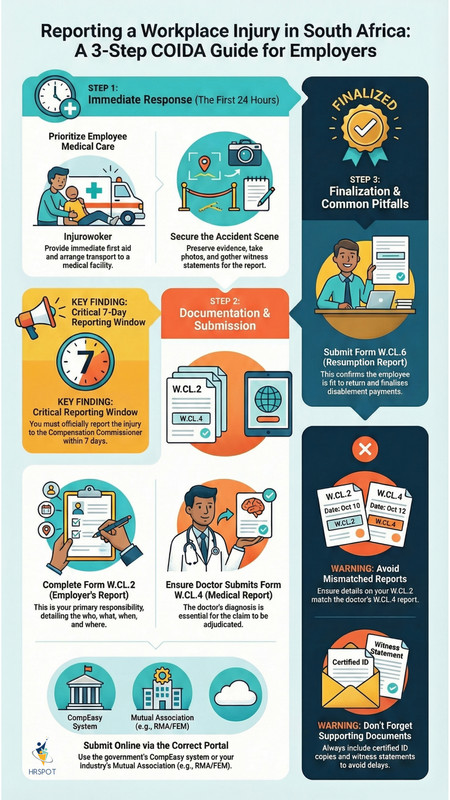
To effectively report an injury on duty (IOD) in South Africa, employers must promptly complete and submit Form W.CL.2, the Employer’s Report of Accident, primarily through the Department of Employment and Labour’s CompEasy system, within a strict 7-day window from the date of the incident. This ensures compliance with the Compensation for Occupational Injuries and Diseases Act (COIDA) and facilitates employee access to necessary medical compensation.
As a small business owner or HR manager in South Africa, navigating the aftermath of a workplace accident can be daunting. Your immediate concern is your employee’s well-being, but legal compliance under the Compensation for Occupational Injuries and Diseases Act (COIDA) is equally critical. This guide cuts through the complexity, providing direct, actionable steps to efficiently report an injury on duty and mitigate potential risks.
Disclaimer: This article is intended for informational purposes only and does not constitute legal advice. Employers should consult with a labour law professional or the Department of Employment and Labour for specific guidance pertaining to their unique circumstances.
1. Understanding Your Obligations Under COIDA
COIDA (Act No. 130 of 1993) is designed to protect both employees and employers. For employees, it provides compensation for disablement, illness, or death caused by occupational injuries or diseases sustained in the course of their employment. For employers, it offers indemnity against civil claims for damages, provided they comply with the Act. Understanding how to report injury on duty effectively starts here.What qualifies as an Injury on Duty (IOD)?
An IOD is generally defined as an injury that arises out of and in the course of an employee’s employment. This includes accidents at the workplace, during work-related travel, or while performing work duties. It also extends to occupational diseases contracted due to the nature of work. The key is the direct link between the injury/disease and the employment.The role of the Compensation Fund vs. Mutual Associations
Most employers in South Africa are covered by the state-run Compensation Fund. However, some sectors, primarily mining and construction, are covered by accredited Mutual Associations like Rand Mutual Assurance (RMA) or Federated Employers Mutual (FEM). It’s crucial to identify your insurer, as reporting portals and procedures differ significantly. Confirming this upfront prevents misdirection and delays.2. Step 1: Immediate Actions Following the Incident
Your responsibility begins the moment an accident occurs. Prompt and appropriate initial actions are vital for the employee’s welfare and the integrity of your IOD report.First aid and emergency medical transport
The absolute priority is the injured employee’s health. Provide immediate first aid and, if necessary, arrange for emergency medical transport to the nearest suitable medical facility. Ensure the employee receives appropriate medical attention without delay.Securing the scene for investigation
After ensuring safety, secure the accident scene. This means preventing further injury and preserving evidence for any necessary investigation. Take photographs, gather witness statements, and document the conditions. This information will be crucial for completing the W.CL.2 form accurately. When sending the employee to a doctor, ensure they take Part B of the W.CL.2 form.3. Step 2: The Critical 7-Day Reporting Window
Time is of the essence when reporting an IOD. South African legislation imposes strict deadlines, and missing them can lead to significant consequences for your business. The Compensation for Occupational Injuries and Diseases Act mandates that all workplace injuries must be reported to the Compensation Commissioner (or relevant Mutual Association) within 7 days of the incident. For occupational diseases, this window extends to 14 days from diagnosis or suspicion. 💡 Warning: Failure to report within these prescribed periods can result in fines and penalties for the employer. Late reporting can also cause delays or even rejection of the employee’s claim, potentially exposing your business to civil liability. Always prioritise timely submission.4. Step 3: Essential Documentation and Forms (The W.CL Series)
Accurate and complete documentation is the backbone of a successful IOD claim. Familiarise yourself with the specific forms required, primarily from the ‘W.CL’ series.The W.CL.2: Employer’s Report of Accident
This is your primary responsibility. The W.CL.2 form details the accident, the nature of the injury, and the immediate actions taken. You must provide a comprehensive account of “who, what, when, where, and how” the injury occurred.The W.CL.4: First Medical Report
This form is completed by the medical practitioner who first treated the employee. It details the diagnosis, treatment plan, and estimated period of disablement. Without a properly completed W.CL.4, the Compensation Fund cannot adjudicate the claim. Ensure the doctor receives your W.CL.2 Part B to facilitate their completion of the W.CL.4.Certified ID copies and witness statements
Always include certified copies of the employee’s ID document. Witness statements, if available, provide crucial corroborating evidence and should be attached to the W.CL.2. Here’s a quick reference table for the key forms:| Form Number | Name | Who Completes It | Deadline (for employer) | Purpose |
|---|---|---|---|---|
| W.CL.2 | Employer’s Report of Accident | Employer | 7 days | Initial report of the incident |
| W.CL.4 | First Medical Report | Medical Practitioner | As soon as possible | Medical assessment, diagnosis, and treatment plan |
| W.CL.5 | Progress Medical Report | Medical Practitioner | Monthly (if applicable) | Updates on employee’s recovery and continued disablement |
| W.CL.6 | Resumption Report | Employer / Medical Aid | Upon return to work | Confirms employee’s fitness to return to work, finalises TTD |
5. Step 4: How to Submit the Claim Online (CompEasy vs. Manual)
The Department of Employment and Labour primarily uses digital platforms for IOD submissions.Navigating the CompEasy system
The CompEasy system is the official online portal for submitting IOD claims to the Compensation Fund. You will need to register your business on this platform if you haven’t already. Once registered, you can upload the completed W.CL.2 and W.CL.4 forms, along with supporting documents. 💡 Pro Tip: Keep screenshots of your submission confirmation and reference numbers from CompEasy. The system can occasionally be temperamental, so having a digital record of successful submission is invaluable. Ensure you use a compatible web browser.Submitting via Mutual Associations (FEM/RMA)
If your business is covered by a Mutual Association like FEM or RMA, you must use their specific online portals or follow their established manual submission procedures. Do not submit to CompEasy if you are covered by a Mutual Association, as this will lead to rejection and significant delays. Check your industry affiliation to confirm your correct reporting channel.6. Step 5: Managing Medical Progress Reports
Reporting the initial injury is not a once-off task. For prolonged absences, ongoing communication and documentation are essential.Submitting the W.CL.5 (Progress Medical Report)
If an employee is booked off work for an extended period, the treating medical practitioner is required to submit a W.CL.5 (Progress Medical Report) monthly. This report updates the Compensation Fund on the employee’s recovery status, continued disablement, and prognosis. It’s your role as the employer to ensure these are submitted to avoid delays in compensation.Handling prolonged absence from work
Maintain regular, respectful communication with your employee regarding their recovery and progress. This ongoing engagement helps with case management and ensures you are informed about their potential return to duty. This also helps with the eventual calculation of Temporary Total Disablement (TTD).7. Step 6: Finalising the Claim and Resumption of Duty
The final steps involve formally closing the claim and facilitating the employee’s return to work.The W.CL.6: Resumption Report
Once the employee is declared fit to return to work by a medical practitioner, a W.CL.6 (Resumption Report) must be submitted. This form confirms their fitness and the date of their return, triggering the finalisation of Temporary Total Disablement (TTD) payments.Calculating Temporary Total Disablement (TTD)
Employers are often required to pay the employee for the first three months of temporary total disablement directly. You can then recoup these wages from the Compensation Fund once the claim is adjudicated. Clearly document all payments made during this period, as you will need this for reimbursement. This process is a major cash-flow consideration for small businesses, so understanding it upfront is key.Common Mistakes That Lead to Claim Rejection
Avoiding common pitfalls can save significant time and frustration. Be meticulous in your submission process:- Discrepancies: Ensure consistency between the employer’s report (W.CL.2) and the medical report (W.CL.4). Contradictory information often leads to rejection.
- Missing Documentation: Incomplete submissions, such as missing certified ID copies or omitted sections of forms, are frequent causes of delays.
- Incorrect Banking Details: Double-check that the employee’s banking details are accurate and correctly captured for direct payments.
- Late Submission: As highlighted, missing the 7-day (injury) or 14-day (disease) deadline can severely jeopardise the claim.
- Wrong Portal: Submitting to the Compensation Fund when you should be using a Mutual Association’s portal (or vice versa) will result in automatic rejection.
Legal Consequences of Failure to Report
Non-compliance with COIDA is not merely an administrative oversight; it carries serious legal ramifications. Employers who fail to report an injury on duty as prescribed can face hefty fines and penalties under the Act. In severe cases, deliberate non-compliance could lead to prosecution. Furthermore, failure to report properly may remove your indemnity against civil claims, potentially exposing your business to significant lawsuits from injured employees. It’s not just about paperwork; it’s about legal protection and ethical responsibility.Frequently Asked Questions
How do you claim for Injury on Duty (IOD) in South Africa?
To claim for Injury on Duty (IOD) in South Africa, the employer reports the incident to the Compensation Fund within 7 days using Form W.CL.2 (Employer's Report of Accident), along with a First Medical Report (W.CL.4) from the treating doctor. Claims are submitted via the Compensation Fund's CompEasy online portal, or through the relevant Mutual Association if the employer is insured privately.
How long do I have to report an injury on duty in South Africa?
You must report an injury on duty to the Compensation Commissioner or relevant Mutual Association within 7 days of the incident. For occupational diseases, the reporting period is 14 days from diagnosis or suspicion.
What forms are needed for an IOD claim?
The primary forms are the W.CL.2 (Employer's Report of Accident) and the W.CL.4 (First Medical Report from the doctor). Depending on the case, W.CL.5 (Progress Medical Report) and W.CL.6 (Resumption Report) may also be required.
What if the CompEasy system isn't working?
While CompEasy is the primary method, if you encounter persistent technical issues, contact the Department of Employment and Labour directly for alternative submission methods or assistance. Always document your attempts to submit, e.g., screenshots of error messages.
Disclaimer: This article is intended for informational purposes only and does not constitute legal advice. Employers should consult with a labour law professional or the Department of Employment and Labour for specific guidance pertaining to their unique circumstances.