In South Africa, the difference between an “employee” and an “independent contractor” is not what you write at the top of the contract. It is what actually happens between you and the person doing the work. Get that wrong, and the consequences land on your business from three directions at once: the Commission for Conciliation, Mediation and Arbitration (CCMA), the South African Revenue Service (SARS), and the Department of Employment and Labour. With the Labour Law Amendment Bill published in February 2026, and the BCEA earnings threshold rising to R269 600.90 per annum from 1 May 2026, worker classification has shifted from a quiet compliance issue to one of the most expensive risks on your books.
1. Why Misclassification Is the Costliest Mistake in SA HR
The phrase “we just gave them an independent contractor agreement” is one of the most expensive sentences in South African business. The courts, the CCMA and SARS all apply a substance-over-form principle. They look at the actual day-to-day relationship, not the label on the contract.
When a misclassification is uncovered, the exposure stacks up quickly:
- CCMA unfair dismissal claims: Terminating a “contractor” who is found to be an employee is automatically procedurally unfair. Compensation of up to 12 months’ remuneration is possible, plus reinstatement.
- BCEA back-pay: Leave, overtime, sick leave and public holiday pay apply retrospectively from day one of the relationship.
- PAYE liability with SARS: The employer becomes liable for all outstanding Pay As You Earn. SARS may impose interest, a 10% late-payment penalty, and an understatement penalty of between 0% and 200% of the outstanding tax depending on the employer’s culpability.
- UIF and SDL arrears: Unpaid Unemployment Insurance Fund contributions and Skills Development Levies, with penalties.
- COIDA exposure: If the “contractor” was injured on duty, the employer may carry unfunded liability under the Compensation for Occupational Injuries and Diseases Act.
In practical terms, a single misclassified worker engaged for three years can expose an SME to several hundred thousand rand in combined back-pay, tax, contributions and penalties, before legal fees.
⭐ Key Takeaway: Misclassification is not a single risk. It is a stack of overlapping risks across labour law, tax law and social security law. The label on the agreement is the first thing the CCMA disregards.
2. Section 200A of the LRA: The Presumption of Employment
Section 200A of the Labour Relations Act, 66 of 1995, together with the mirror provision in section 83A of the Basic Conditions of Employment Act, creates a rebuttable presumption of employment. In plain language: if any one of seven listed factors is present, the person is presumed to be an employee until the employer proves otherwise.
The presumption applies to workers earning at or below the BCEA earnings threshold, which the Minister of Employment and Labour increased to R269 600.90 per annum (R22 466.74 per month) with effect from 1 May 2026 under Government Notice 7384 of 17 April 2026.
Three points often missed by employers:
- Only one factor needs to be present. The applicant does not need to tick all seven boxes.
- The onus shifts to the employer. Once the presumption is triggered, you must prove to the CCMA, on a balance of probabilities, that the person is genuinely independent.
- The contract is irrelevant. Section 200A applies “regardless of the form of the contract”.
For workers earning above the threshold, the same seven factors are used by the CCMA and courts as a guide under the “dominant impression test” established in SABC v McKenzie (1999). You do not escape scrutiny simply because you pay your “contractor” R30 000 a month.
💡 Tip: The Code of Good Practice: Who is an Employee, issued by NEDLAC under section 200A(4), is binding interpretive guidance. CCMA commissioners must take it into account.
3. The Seven Factors: A Walk-Through
Each factor below appears in section 200A(1) of the LRA.
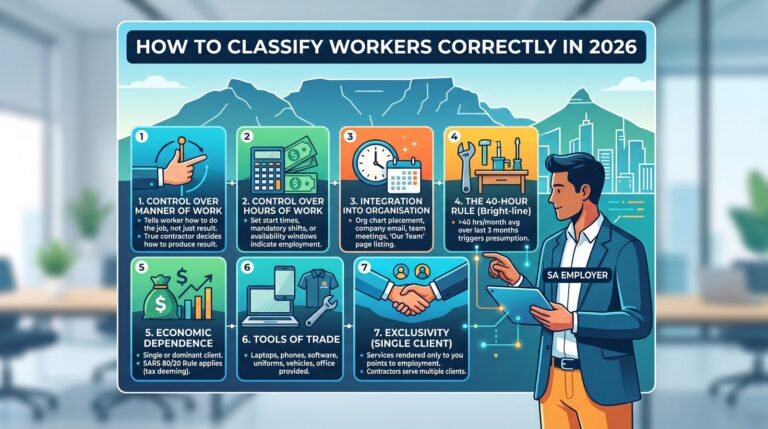
Factor 1 — Control over the manner of work: If you tell the worker how to do the job — not just what the deliverable is — you are exercising control. A true contractor is hired to produce a result and decides how to produce it.
Factor 2 — Control over hours of work: Set start times, mandatory shifts or required availability windows all indicate employment. A genuine contractor decides when to work.
Factor 3 — Integration into the organisation: Does the worker appear on the org chart, have a company email address, attend team meetings, get listed on the “Our Team” page? Integration is one of the strongest indicators of employment.
Factor 4 — The 40-hour rule: If the person has worked an average of at least 40 hours per month over the last three months, the presumption is automatically triggered. This is the bright-line test.
Factor 5 — Economic dependence: If you are the contractor’s only client, or you provide the overwhelming majority of their income, they are economically dependent. SARS applies a similar principle through its 80/20 rule: if more than 80% of a contractor’s income comes from a single client, SARS may deem them an employee for tax purposes.
Factor 6 — Tools of trade: Laptops, mobile phones, software licences, branded uniforms, vehicles, office space — anything significant that you provide is evidence of employment. True contractors use their own equipment.
Factor 7 — Exclusivity (single client): If the worker only renders services to you, this points squarely at employment. Genuine contractors run a business and serve multiple clients.
⭐ Key Takeaway: Only one of these seven factors needs to be present to trigger the presumption. Most “contractor” arrangements in South African SMEs trip at least three or four.
4. The Worker Classification Decision Flowchart
Use this sequence before engaging anyone on a contractor basis, and audit your existing engagements against it:
- Does the person earn at or below R269 600.90 per annum? If yes → Section 200A presumption applies. If no → the dominant impression test applies using the same factors.
- Is any one of the seven factors present? If yes → presumption triggered.
- Can you genuinely rebut the presumption? Test honestly: Do they have other clients? Use their own tools? Set their own hours? Issue invoices in the name of a registered business?
- If you cannot rebut → reclassify as an employee. Register them for PAYE, UIF and SDL. Issue an employment contract.
- If you can rebut → document the rebuttal evidence. Keep proof of their other clients, their own equipment, and invoices on their own letterhead.
💡 Tip: If the answer is borderline, section 200A(3) of the LRA allows any party to approach the CCMA for an advisory award on classification. This is a low-cost way to get certainty before a dispute arises.
5. How the 2026 Labour Law Amendment Bill Strengthens the Presumption
The Labour Law Amendment Bill, published in Government Gazette 54220 on 26 February 2026, is the most significant overhaul of South African labour legislation in over a decade. For employers using freelancers, gig workers and platform staff, two changes matter most.
Schedule 11 to the LRA. The Bill introduces a new Schedule 11 creating a presumption of employment for non-standard workers — including platform workers, delivery drivers, home-based service providers and dependent contractors — unless the employer can prove the worker is genuinely independent. To rebut the presumption, the employer must show the worker is not controlled by the organisation, not integrated into it, and not performing work on the organisation’s behalf under the organisation’s terms.
Section 9B of the BCEA (proposed). This new section will introduce minimum pay guarantees and advance notice obligations for “on-call” workers. The era of unregulated zero-hour contracts in South Africa is ending.
The practical effect for businesses engaging app-based drivers, on-call cleaners and freelance designers is that the legal threshold for deeming workers employees is being lowered. The Bill is currently in the public comment phase, but the direction of travel is already shaping CCMA and Labour Court interpretation.
⭐ Key Takeaway: Do not wait for the Bill to be promulgated. The legal and regulatory direction is set. Audit your independent contractor arrangements now.
6. Three Worked Examples
Example 1: The Ride-Hailing Driver
A driver signs up with a ride-hailing platform. He uses his own car, is paid per trip, and can log on and off when he wants. On paper, he is independent.
In reality: the platform sets the price, allocates trips through its algorithm, suspends drivers based on ratings, and requires acceptance of a minimum percentage of trips.
Analysis: Control over the manner of work (Factor 1) is exercised through algorithmic management. Hours are effectively controlled through forced acceptance rates (Factor 2). Many drivers are economically dependent on a single platform (Factor 5). Under the proposed Schedule 11, the presumption of employment is almost certainly triggered.
Example 2: The Recurring Freelance Designer
A graphic designer has invoiced your company R18 000 per month for the last 18 months. She works on briefs you send, from her own laptop, on her own hours. She has two other clients.
Analysis: No control over manner of work (no Factor 1). No control over hours (no Factor 2). She uses her own tools (no Factor 6). She has other clients (no Factor 7). She may or may not breach the 40-hour rule depending on actual hours worked.
Outcome: Most likely a genuine independent contractor relationship, provided the documentation matches reality. Keep her invoices and evidence of her other clients on file.
Example 3: The On-Call Cleaner
You have a “contractor” cleaner who comes in three times a week, uses your cleaning products and equipment, works the hours you specify, wears a uniform you provided, and has cleaned for you exclusively for two years. She earns R4 500 a month.
Analysis: Control over hours (Factor 2). Tools provided by you (Factor 6). Exclusivity (Factor 7). Almost certainly the 40-hour rule applies (Factor 4). She earns far below the threshold, so Section 200A applies in full force.
Outcome: She is an employee. The fact that you call her a contractor and pay her without deducting PAYE creates serious exposure with SARS, UIF, the Department of Employment and Labour, and potentially the CCMA.
7. How to Fix a Misclassification Before SARS or the CCMA Finds It
If you realise you have one or more misclassified workers, voluntary correction is the right move. Doing nothing is the worst option, because the longer the misclassification continues, the larger the back-pay exposure becomes.
A structured remediation process looks like this:
- Conduct a classification audit. List every person engaged on a non-employment basis. Score each against the seven factors. Flag any that trip one or more.
- Get specialist advice on borderline cases. A labour law practitioner or a CCMA advisory award can give certainty.
- Reclassify proactively. Issue a proper employment contract going forward. Register the worker for PAYE, UIF and SDL.
- Use the SARS Voluntary Disclosure Programme (VDP) for the tax piece. Approaching SARS proactively under the VDP typically reduces understatement penalties significantly compared to detection by audit.
- Settle backdated BCEA entitlements. Agree the position with the worker in writing and settle.
- Update your engagement processes. Train managers on the seven factors. Build the test into procurement and HR onboarding.
💡 Tip: “Freelancer creep” — where short-term project workers gradually turn into permanent fixtures — is the source of most SME misclassification problems. A quarterly review of every contractor relationship catches this early.
8. Independent Contractor Agreement Clauses That Actually Hold Up
A bullet-proof contract cannot turn an employee into a contractor. But a well-drafted agreement that matches the reality of an independent relationship helps rebut the Section 200A presumption. Clauses that genuinely assist include:
- Deliverable-based scope: Define outcomes, not activities. “Contractor shall deliver X by Y date” — not “Contractor shall work Monday to Friday from 08:00 to 17:00.”
- Autonomy clause: Expressly state the contractor decides the manner, method, hours and location of work.
- Own tools and equipment: Confirm the contractor uses their own equipment, software and infrastructure.
- Right to subcontract: Permit the contractor to delegate or subcontract. Employees cannot subcontract their jobs.
- No exclusivity: Confirm the contractor may render services to other clients during the term.
- Fee-based remuneration: Pay against invoices for deliverables, not a fixed monthly salary regardless of output.
- No employment benefits: Explicitly exclude leave, sick pay, medical aid, pension and any other employee benefit.
- Own tax responsibility: The contractor warrants they are registered as a provisional taxpayer and will account for their own income tax, VAT and statutory contributions.
- Termination by notice or for cause: Project-based or notice-period termination, not the protected dismissal regime applicable to employees.
⭐ Key Takeaway: Contract clauses must match operational reality. If you draft an autonomy clause and then send the “contractor” daily instructions, the CCMA will side with what actually happened, not what the contract said.
Frequently Asked Questions (FAQ)
What is the BCEA earnings threshold for 2026?
From 1 May 2026, the BCEA earnings threshold is R269 600.90 per annum (R22 466.74 per month), set by Government Notice 7384 of 17 April 2026. Workers earning at or below this threshold are entitled to the full Section 200A presumption of employment.
Can a written independent contractor agreement override the presumption of employment?
No. Section 200A applies “regardless of the form of the contract”. The CCMA, courts and SARS apply the substance-over-form principle and look at the actual working relationship. A signed contractor agreement is only useful where it accurately reflects an independent relationship.
How many of the seven factors must be present for someone to be presumed an employee?
Only one. If any single factor in section 200A(1) is present, the presumption is triggered and the onus shifts to the employer to prove the person is genuinely an independent contractor.
What happens if SARS finds I misclassified an employee?
SARS may assess all outstanding PAYE, plus interest, a 10% late-payment penalty, and an understatement penalty of between 0% and 200% of the outstanding tax depending on the employer’s culpability. UIF and SDL arrears will also be raised. The Voluntary Disclosure Programme can significantly reduce understatement penalties for employers who come forward proactively.
Does the proposed 2026 Labour Law Amendment Bill apply already?
Not yet. The Bill is in the public comment phase prior to Parliamentary consideration. However, the existing Section 200A presumption is already in force, and the courts are increasingly interpreting the existing law in line with the direction set by the Bill.
Conclusion
Worker classification in South Africa in 2026 is no longer a paperwork exercise. It is a strategic risk that sits across labour law, tax law and social security law, and the regulatory environment is moving decisively in favour of the worker. Section 200A of the LRA, the proposed Schedule 11, the increased BCEA threshold and SARS’ anti-avoidance posture all point in the same direction.
The good news is that the seven factors are clear, the test is workable, and proactive remediation is significantly cheaper than reactive enforcement. Audit your contractors now. Reclassify where necessary. Match your contract clauses to your operational reality. And when in doubt, seek an advisory award from the CCMA or specialist labour law advice before the dispute lands on someone else’s desk.
Disclaimer: This article provides general information and guidance on worker classification in South Africa. It is not intended as legal advice. Employers should consult with a qualified labour law professional and tax practitioner for advice specific to their circumstances.