South Africa remains a landscape of profound economic contrasts. The tension between high executive earnings and the struggles of the “working poor” has reached a boiling point, exacerbated by a recessionary climate that has stripped many households of their basic security.
As Professor Klaus Schwab, Founder of the World Economic Forum, aptly noted, the global pandemic provided a “rare but narrow window of opportunity to reflect, reimagine, and reset our world.”
In the South African corporate sector, this “Great Reset” acts as a catalyst for reimagining how we value work and the social license of the executive. We are no longer simply looking at profit; we are interrogating the sustainability of value creation in a society where job insecurity and hunger are rising.
This post distills surprising, data-driven takeaways from recent remuneration trends and payroll data to offer a strategic roadmap for boards and remuneration committees (RemCos).
1. The Drucker Principle vs. The South African Reality
The “Drucker Principle,” established by management theorist Peter Drucker in the 1980s, suggests that an ideal ratio of CEO-to-average-worker pay is roughly 20:1 or 25:1. Drucker warned that exceeding this threshold breeds employee resentment and erodes morale.
When we synthesise current data from the JSE overall, the South African reality is more nuanced than the headlines suggest. Comparing median CEO Total Guaranteed Pay (TGP) to the National Minimum Wage (NMW) reveals a shocking disparity. However, when compared to the median pay for unskilled or semi-skilled workers, we find a “surprising” alignment with Drucker’s original ideal.
To maintain technical authority, we must look at the post-tax reality. Using the 2025/26 tax tables where income exceeding R1,817,000 is taxed at a marginal rate of 45%. The take-home reality shifts significantly.
Post-Tax Ratios for JSE Overall
Based on a median CEO TGP of R5,242,000 (Pre-tax) and NMW calculated at R28.79/hour.
| Lower-level Income Reference Point | Ratio to Median CEO TGP (Post-Tax) |
| National Minimum Wage (NMW) | 66 times |
| Unskilled Median | 24 times |
| Semi-skilled Median | 18 times |
The 66x ratio against the NMW illustrates why public outcry remains so high, yet the 18x–24x range against unskilled and semi-skilled medians suggests that executive fixed pay is more defensible than commonly perceived, provided the benchmark is the actual workforce median rather than the legislative floor.
2. The “Ratcheting Effect” – The Hidden Flaw in Benchmarking
Benchmarking is often treated as an objective science, yet in practice, it often functions as a “ratcheting effect” that fuels perpetual pay inflation. This occurs when companies adjust pay upward to meet the 50th percentile (median) but never adjust it downward when they find themselves above it.
From a strategic perspective, many RemCos use benchmarking as a “safety net” to avoid shareholder backlash. There is a palpable “first-mover disadvantage”, a fear among boards to shift their remuneration philosophy in the absence of legislation.
Furthermore, benchmarking often fails because of “aspirational” comparator groups. Management frequently provides input to include significantly larger or more complex organisations in their peer group, artificially inflating the benchmark. To move beyond this paternalistic solo metric, RemCos should incorporate fair-pay measures like the Gini coefficient or the Palma ratio alongside traditional salary surveys.
3. Rewarding “Value Safeguarding” Instead of Growth
In an environment characterised by “free fall,” the traditional philosophy of rewarding absolute growth becomes impossible. This has given rise to the “defensive strategy.” In this context, bonuses paid during a downturn are not just “payouts for failure”; they are a fiduciary necessity to prevent the destruction of institutional memory.
Defensive Strategy vs. Traditional Growth
-
Traditional Approach: Relies on absolute performance (growth against a company’s own aspirations) or equity-settled LTIs with zero downside risk.
-
Defensive Strategy: Rewards management for relative performance. If the market index contracts by 20% but the company only contracts by 10%, management is seen as having safeguarded value.
While paying bonuses during a recession is controversial, these “turnaround incentives” are often essential to keep the company afloat and avoid mass retrenchments.
4. Shifting the Focus: The Case for the Living Wage
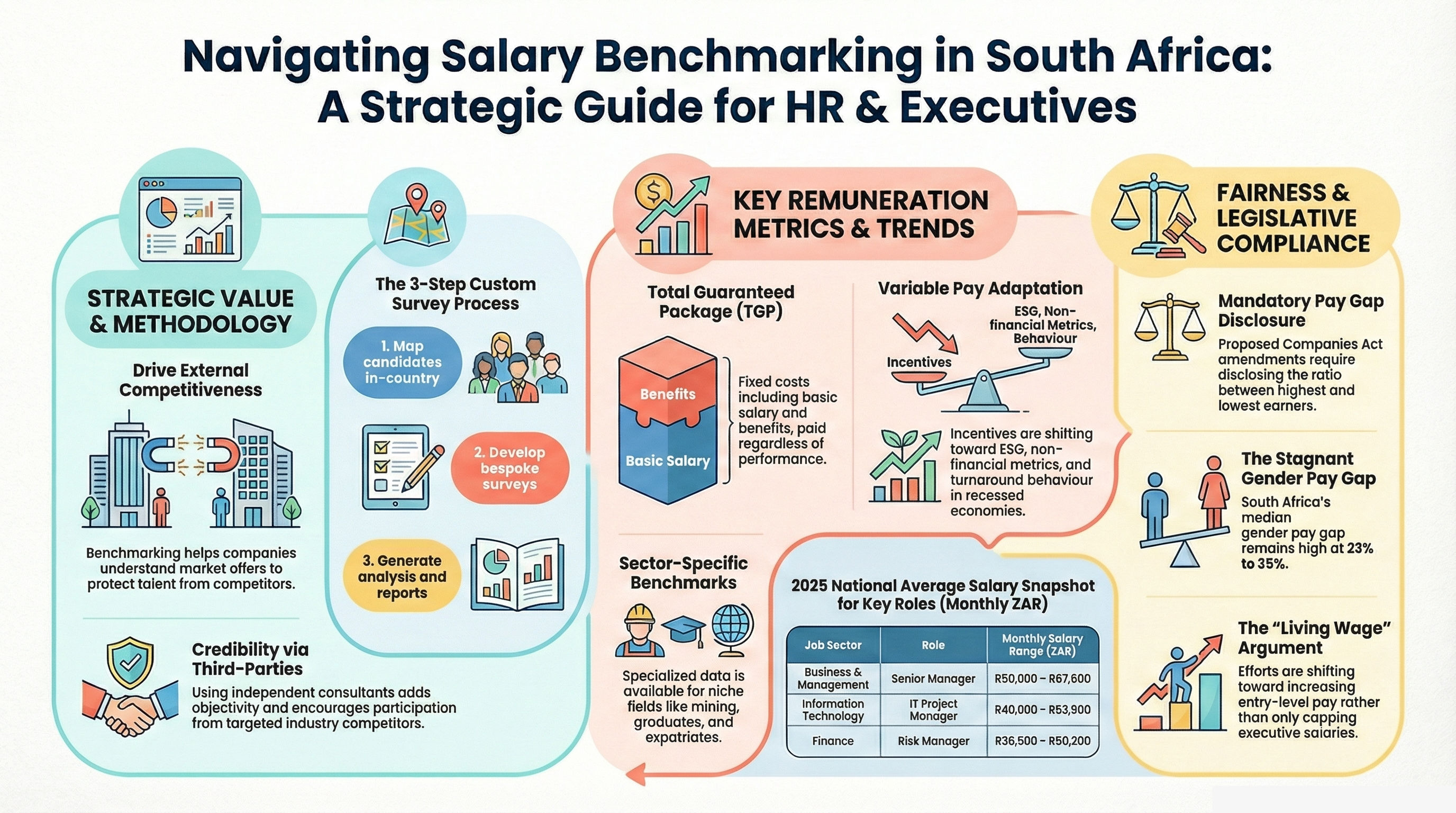
There is a powerful argument that efforts to reduce income disparity are better spent raising the “bottom” rather than capping the “top.” If we lift the entry-level floor to a “Living Wage,” the executive pay ratios naturally realign to a defensible range.
-
The Math: In South Africa, a pre-tax Living Wage is defined at approximately R12,000 per month.
-
The Result: Applying the Drucker Principle (20:1 to 25:1) to this floor results in a CEO TGP range of R5.25 million to R6.60 million. Interestingly, the majority of JSE CEOs already fall near this range for fixed pay.
“The struggles that we have witnessed during the lockdown make it difficult to believe that anything lower than a living wage is fair, or sustainable.” PwC Analysis
Boards must also account for the BCEA earnings threshold, which rised to R261,748.45 in April 2025. This threshold complicates the “fair pay” debate, as it dictates which employees are entitled to statutory protections.
5. Retention is Brain Science, Not Just Rand and Cents
When “throwing money at the problem” is no longer an option, organisations must turn to neuroscience to retain talent. This involves the SCARF model (Status, Certainty, Autonomy, Relatedness, Fairness).
Retention is as much about culture as it is about cash. For instance, data shows that average CEO tenure varies significantly by industry, peaking at 8.5 years in some sectors.
The Tax-Efficiency Multiplier
At the 45% top marginal tax rate (income > R1,817,000), the “real” value of a pre-tax benefit is nearly double its cost to the company. Strategic Human Capital Analysts should leverage this to maximise take-home pay through creative tools:
-
Pre-tax Canteen Meals: Using Section 12 of the Income Tax Act to provide food on-site.
-
Flexible Working Locations: Reducing employee travel costs and company real estate footprints.
-
Restricted Equity Funds (REF): New generation savings plans that provide better long-term appreciation than traditional retirement funds.
6. The “S” in ESG – Pay as a Social Justice Tool
The “Social” in ESG is no longer a PR exercise; it is a tool for systemic justice. The data reveals shocking gaps in representation and pay within the JSE.
The Gender Gap
-
Representation: Women comprise only 14% of the JSE Executive Director population.
-
CEOs: There are only 19 female CEOs (5.8%) across the JSE.
-
Pay Gap: The gap is widest in male-dominated industries like Mining and Real Estate, reaching a 34% median gap.
The Race Gap
-
Representation: In the JSE Top 100, Black African, Coloured, and Indian/Asian CEOs make up only 14%.
-
Pay Gap: While the median pay gap is 15%, it balloons to a 37% gap at the upper quartile.
Regulatory Pressure: The “Two-Strike” Rule
Proposed Companies Act amendments may introduce the “two-strike” rule borrowed from Australia. If a remuneration policy is rejected by 25% or more of shareholders at two consecutive AGMs, the RemCo must resign. However, technical authority suggests this is more of a “lightning rod” for general shareholder displeasure than a functional tool; in Australia, to date, no board spill resolution has ever been carried.
Conclusion: Towards Stakeholder Capitalism
The South African remuneration landscape is moving decisively away from singular shareholder emphasis toward Stakeholder Capitalism. This model prioritises employees, lenders, and the community alongside investors.
As we navigate the 2025/26 tax realities, including the 45% top marginal rate and the R633,168 COID limit, RemCos must look beyond simple bonuses. The pandemic provided a window to “reset” our structures. The question remains: Are we building pay structures that prioritise sustainable value, or are we simply waiting for the next “free fall” to test our resilience?