This article thoroughly explores the critical intersection of AI and HR data privacy, specifically focusing on safeguarding employee information for small business owners. It identifies key privacy concerns, from opaque data collection and algorithmic bias to security vulnerabilities, and offers comprehensive best practices and solutions. The article highlights the importance of proactive measures, POPIA compliance, and a privacy-by-design mindset to build trust and ensure ethical AI integration in HR.
AI and HR data privacy involves securing sensitive employee information processed by artificial intelligence systems. This is critical for small business owners to prevent data breaches, ensure compliance with evolving regulations like POPIA, and maintain employee trust in an increasingly automated workplace, transforming potential risks into strategic advantages.
In a rapidly evolving digital landscape, artificial intelligence (AI) is no longer a futuristic concept but a present-day reality profoundly reshaping the human resources (HR) function across businesses of all sizes. For small business owners, the allure of AI’s efficiency, predictive capabilities, and analytical prowess in HR is undeniable – from streamlining recruitment to optimising performance management and even fostering employee well-being. However, this transformative power comes with a critical caveat: the immense responsibility of safeguarding employee data privacy.
As a thought leader in this space, I contend that the ethical and secure integration of AI in HR isn’t merely about regulatory adherence; it’s a strategic imperative for building enduring trust, fostering a positive organisational culture, and ensuring the long-term sustainability of your enterprise. The intricate dance between technological advancement and fundamental human rights to data privacy demands a visionary approach, especially when dealing with sensitive employee data.
This article will navigate the complex intersections of AI and HR, dissect the AI ethics challenges, and illuminate a clear path for robust data protection, providing actionable solutions for discerning small business owners in South Africa and beyond.
The Intersections of AI, HR, and Employee Data Privacy: A Confluence of Challenge and Opportunity

The convergence of artificial intelligence and human resources marks a pivotal moment for organisations. AI is transforming traditional HR functions, offering tools that promise unprecedented insights and efficiencies. Yet, this very transformation introduces a new frontier of challenges, particularly concerning the sanctity of employee data privacy.
How is AI transforming HR, and what does it mean for data?
AI’s footprint in HR is extensive and growing. Algorithms are now deployed across the entire employee lifecycle. In recruitment, AI assists with sourcing candidates, screening CVs, conducting initial interviews via chatbots, and even predicting job success. For performance management, AI-powered tools monitor employee engagement, analyse productivity metrics, and offer personalised feedback. Predictive analytics models leverage historical employee data to forecast attrition rates, identify potential skills gaps, or even flag employees at risk of burnout. In the realm of learning and development, AI tailors training programmes to individual needs, while in payroll and benefits, it automates complex calculations and administration.
For small businesses, these tools promise to level the playing field, offering sophisticated capabilities previously exclusive to larger enterprises. Imagine an AI recruitment platform sifting through hundreds of applications in minutes, or a system flagging a dip in team morale before it impacts productivity. The promise is efficiency, fairness, and strategic insight.
Why does this intersection create unique privacy challenges for small businesses?
While the benefits are clear, the mechanisms underpinning these AI tools – the collection, processing, and analysis of vast datasets – inherently give rise to unique privacy challenges. Traditional HR data management, often confined to structured information like personal details, salary, and performance reviews, operated within relatively clear boundaries. AI, however, thrives on unstructured data – emails, chat logs, video interactions, biometric data, sentiment analysis from communications, and even passively collected information about device usage patterns.
This shift moves HR into a realm where the scope of data collection is broader, its analysis more pervasive, and its potential inferences far more intimate. For small businesses, already stretched thin on resources and often lacking dedicated legal or data privacy departments, navigating this complexity becomes a significant hurdle. They often rely on third-party AI HR solutions, which introduces additional layers of data sharing and control concerns. The lack of transparency in how many AI systems function – often referred to as the “black box” problem – makes it difficult to understand precisely what employee data is being collected, how it’s being processed, and what decisions are being made based on it. This opacity fundamentally undermines the principles of data privacy and trust.
Key Privacy Concerns: From Data Collection to Algorithmic Use – What are the Stakes?
The true extent of AI and HR data privacy becomes apparent when we scrutinise the specific privacy issues arising from AI’s integration into human resources. These aren’t just theoretical risks; they represent tangible threats to individual rights and organisational integrity.
What are the privacy issues with AI in HR that small businesses should address?
The deployment of AI in HR introduces several critical privacy issues that small business owners must proactively address:
- Opaque Data Collection and Monitoring: Many AI HR tools can collect data far beyond what employees might reasonably expect or consent to. This includes tracking keyboard strokes, screen activity, communication patterns, facial expressions during video interviews, and even off-duty social media activity. Such pervasive, often unseen, monitoring blurs the lines between professional and personal life, leading to feelings of surveillance and eroding trust.
- Algorithmic Bias and Discrimination: AI systems learn from historical data. If this data reflects societal biases or past discriminatory practices, the AI will perpetuate and even amplify them. For instance, an AI recruitment tool trained on historical data from a predominantly male industry might inadvertently screen out female candidates, leading to unfair hiring practices and potentially legal challenges. This directly contradicts the principles of AI ethics.
- Data Security Vulnerabilities and Breaches: Consolidating vast amounts of sensitive employee data into AI platforms creates a single, highly attractive target for cybercriminals. A breach of these systems could expose not only personal identifiers but also performance reviews, health information, financial details, and even biometric data, leading to severe reputational damage and financial penalties.
- Lack of Transparency in AI Decision-Making: The “black box” problem means that AI algorithms often make decisions without a clear, human-understandable explanation of how they arrived at a particular outcome. This can be problematic when AI determines who gets an interview, a promotion, or even who is flagged for performance issues. Employees have a right to understand and challenge decisions that affect their careers, a right that becomes difficult to exercise with opaque AI.
- Insufficient Employee Consent and Control: Traditional consent models often fall short in the context of dynamic AI systems. Employees might consent to data collection for one purpose, only for the AI to process it for unforeseen analytical insights or to share it with third parties. Ensuring truly informed and granular consent is a complex but crucial task.
- Unintended Inferences and Profiling: AI can infer highly sensitive personal attributes (e.g., health conditions, mental state, political leanings) from seemingly innocuous data points. This creation of comprehensive employee profiles, often without explicit consent or awareness, raises profound ethical questions and risks discriminatory actions.
How does AI specifically affect employee data privacy in the South African context?
For small businesses in South Africa, these global concerns are amplified by specific local regulations, particularly the Protection of Personal Information Act (POPIA). POPIA is a comprehensive data privacy law that mandates how personal information must be collected, processed, stored, and shared. Its principles directly impact how AI can be deployed in HR:
- Accountability: Organisations remain accountable for employee data even when using AI vendors.
- Processing Limitation: Data must be processed lawfully, transparently, and only for specific, explicit, and legitimate purposes. AI’s ability to infer new insights can easily overstep these limitations.
- Purpose Specification: Data collected for one purpose cannot be used for another without consent, challenging AI’s broad analytical capabilities.
- Minimality: Only necessary data should be collected, directly contrasting AI’s hunger for vast datasets.
- Openness: Data subjects (employees) have a right to know how their data is being processed, which conflicts with opaque AI algorithms.
- Security Safeguards: Strong measures are required to prevent loss, damage, or unauthorised access to personal information, making AI security paramount.
- Data Subject Participation: Employees have the right to access and correct their data and object to its processing, demanding explainable AI mechanisms.
Failure to comply with POPIA can lead to severe penalties, including hefty fines and even imprisonment for responsible individuals. For a small business, such a hit could be catastrophic. The implications extend beyond legal repercussions to the profound erosion of trust among your most valuable assets: your employees.
💬 Expert Insight:
“The integration of AI into HR, while promising efficiency, concurrently demands a heightened sense of ethical responsibility. Small businesses must recognise that the ‘black box’ of AI can inadvertently become a Pandora’s Box if data privacy isn’t prioritised from conception. It’s about more than just legal compliance; it’s about preserving human dignity in an algorithmic age.”
Best Practices for Robust Data Protection in AI-Powered HR: Charting a Secure Path Forward
The challenges posed by AI are significant, but they are not insurmountable. For small business owners, adopting a proactive and principled approach is key to harnessing AI’s power while protecting their employees and their business reputation.
What concrete steps can small businesses take to safeguard employee data with AI?
To effectively navigate the complex landscape of AI-powered HR and data privacy, small businesses should implement a multi-faceted strategy built on foundational principles and operational best practices.
Foundational Principles: Building a Privacy-First Mindset
⭐ Key Insight: A privacy-by-design approach isn’t an afterthought; it’s the bedrock of ethical AI integration in HR.
- Data Minimisation:
- Principle: Only collect the data that is absolutely necessary for a specific, defined purpose. Avoid the temptation to collect “just in case” data.
- Action for Small Businesses: Before implementing any AI HR tool, conduct a thorough assessment of what data points are genuinely required for its stated function. Challenge vendors on their data collection practices.
- 💡 Pro Tip: For each data point collected, ask: “Is this truly indispensable for the AI to perform its intended HR function, or is it merely ‘nice to have’?”
- Purpose Limitation:
- Principle: Define and stick to explicit, legitimate purposes for data usage. Data collected for one reason should not be repurposed without explicit consent.
- Action for Small Businesses: Clearly document the purpose of each AI tool and the data it processes. Ensure that AI outputs are used strictly within these defined purposes.
- Transparency and Informed Consent:
- Principle: Be open and honest with employees about what data is being collected, how AI tools are being used, and how it might impact them. Obtain clear, explicit, and granular consent where legally required.
- Action for Small Businesses: Develop easy-to-understand privacy notices. Explain the AI’s function, the types of data it uses, and the decisions it influences. Provide employees with options to consent or object, where applicable.
- Security by Design and Default:
- Principle: Build privacy protections into AI systems and processes from the outset, rather than trying to patch them on later.
- Action for Small Businesses: When evaluating AI HR solutions, prioritise those with robust security features, end-to-end encryption, and strong access controls. Ensure default settings are privacy-enhancing.
Operational Strategies: Implementing Practical Safeguards
✅ Key Takeaway: Proactive governance, continuous monitoring, and clear policies are essential for dynamic data privacy management.
- Conduct Data Protection Impact Assessments (DPIAs):
- What it is: A process to identify, assess, and mitigate data protection risks associated with new projects or technologies (like AI in HR).
- Action for Small Businesses: Before deploying any new AI HR system, conduct a DPIA. This involves mapping data flows, identifying potential privacy risks (e.g., bias, security vulnerabilities), and planning mitigation strategies. This is a critical step for POPIA compliance.
- Thorough Vendor Due Diligence:
- What it is: Carefully vetting third-party AI HR providers to ensure their data privacy and security practices align with your standards and legal obligations.
- Action for Small Businesses: Ask prospective vendors detailed questions about their data handling, security certifications (e.g., ISO 27001), sub-processors, data retention policies, and compliance with regulations like POPIA. Include robust data protection clauses in all contracts.
- Strong Data Governance Policies:
- What it is: Establishing clear, documented guidelines for the entire lifecycle of employee data within AI-driven HR.
- Action for Small Businesses: Develop and enforce policies covering data access, storage, retention, deletion, and incident response for AI-processed data. Assign clear roles and responsibilities for data stewardship.
- Employee Training and Awareness:
- What it is: Educating your staff about data privacy risks, best practices, and their rights concerning their own data and the data they handle.
- Action for Small Businesses: Regular training sessions for all employees, especially those in HR or IT, on AI and HR data privacy, POPIA requirements, and the ethical use of AI tools. Foster a culture where data protection is everyone’s responsibility.
- Regular Audits and Reviews:
- What it is: Continuously monitoring AI systems and processes to ensure ongoing compliance and effectiveness of privacy safeguards.
- Action for Small Businesses: Schedule periodic reviews of your AI HR systems, data access logs, and data protection policies. Conduct penetration testing or security audits of AI platforms, especially those from third-party vendors.
- Strive for Explainable AI (XAI):
- What it is: Developing or choosing AI systems where decisions can be understood and interpreted by humans.
- Action for Small Businesses: Where possible, opt for AI solutions that offer a degree of transparency or explainability. This allows for auditing of AI decisions and enables employees to understand and potentially challenge outcomes that affect them.
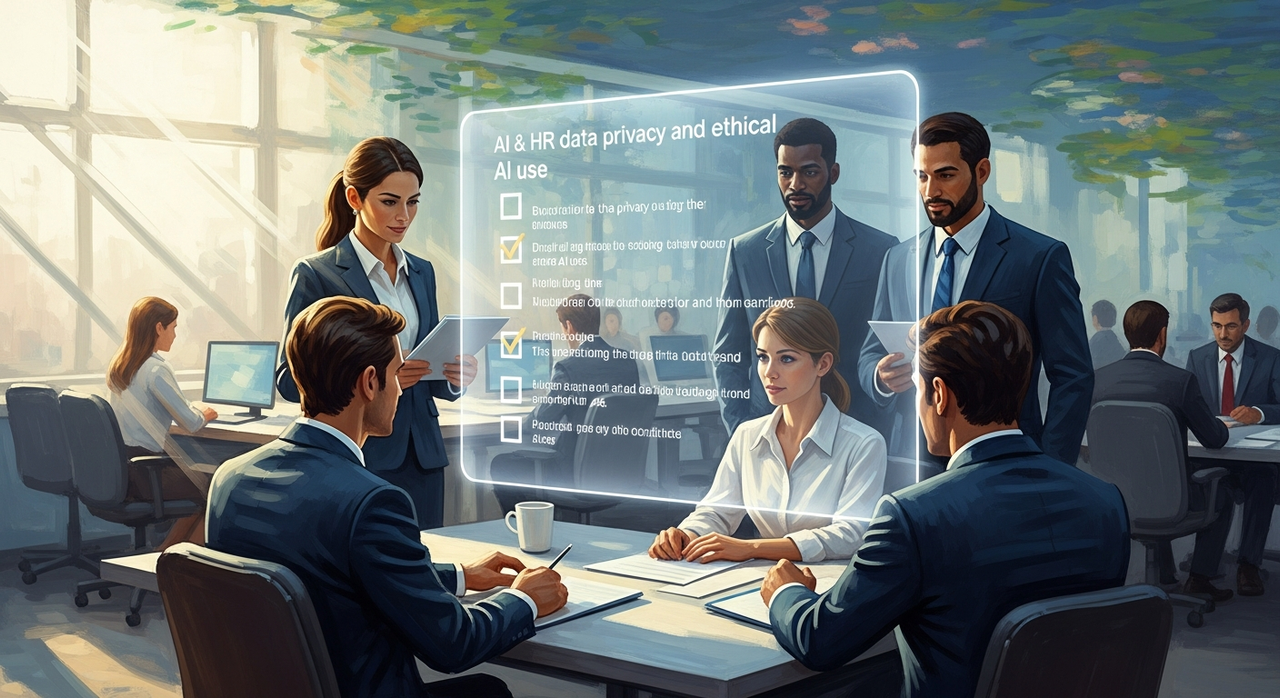
Legal and Ethical Compliance: Adhering to the Mandate
- POPIA Adherence as a Core Mandate:
- What it is: Ensuring all AI HR practices strictly comply with the Protection of Personal Information Act.
- Action for Small Businesses: Appoint an Information Officer as required by POPIA. Conduct regular POPIA compliance assessments. Stay updated on guidance from the Information Regulator. Consider external legal counsel for complex AI implementations.
- [SUGGESTION: Link to a government or regulatory body’s guide on POPIA compliance]
- Embrace AI Ethics Frameworks:
- What it is: Adopting a set of moral principles and values to guide the design, development, and deployment of AI.
- Action for Small Businesses: Consider integrating principles like fairness, accountability, transparency, and human oversight into your AI strategy. This moves beyond mere compliance to responsible innovation, fostering trust and mitigating risks. This is a crucial element of AI ethics.
The journey to securely integrate AI into HR is ongoing, requiring vigilance, continuous learning, and a deep commitment to ethical practice. For small business owners, this isn’t just about managing risk; it’s about leading with integrity in the digital age.
The integration of AI into HR presents an undeniable opportunity for small businesses to enhance efficiency and strategic insight. However, this power is inextricably linked to profound responsibilities, particularly regarding AI and data privacy. As visionary leaders, small business owners must recognise that a proactive, ethical, and legally compliant approach to data protection is not merely a checkbox exercise but a cornerstone of their future success.
By prioritising data minimisation, fostering transparency, rigorously vetting AI vendors, and embedding a privacy-by-design philosophy, businesses can build resilient systems that protect their most valuable asset – their people – and cultivate an environment of trust. Embrace these best practices not as burdens, but as blueprints for a secure, ethical, and prosperous future where technology serves humanity, not the other way around.
Small business owners, the time to act is now. Review your HR data practices, engage with AI solutions critically, and embed a culture of privacy-by-design. Your employees’ trust and your business’s future depend on it.
Frequently Asked Questions
Q: What is the biggest data privacy risk for small businesses using AI in HR? A: The biggest risk is often the unintended collection and misuse of sensitive employee data, leading to algorithmic bias, potential data breaches, and non-compliance with regulations like POPIA, which can severely damage reputation and incur hefty fines.
Q: How can I ensure my AI HR vendor is compliant with data privacy laws like POPIA? A: Conduct thorough due diligence by requesting their security certifications, reviewing their data processing agreements, asking about their sub-processors, and clarifying their data retention and deletion policies. Ensure they commit to POPIA compliance in contractual agreements.
Q: Is employee consent always necessary for AI-driven HR data processing? A: While consent is a key principle of data privacy, POPIA identifies several lawful bases for processing personal information. Consent is often necessary, especially for sensitive data or purposes outside typical employment operations. However, processing may also be justified by legitimate interest, legal obligation, or contractual necessity, provided all other POPIA principles are met. Transparency with employees remains paramount.